
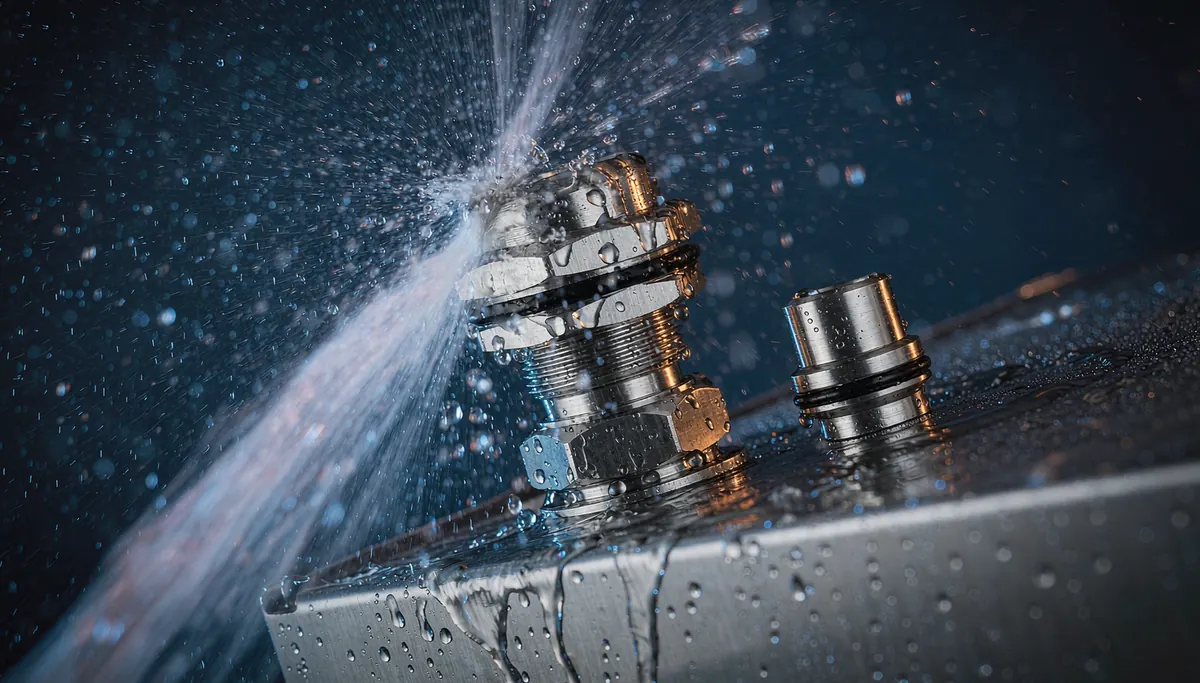
IP69K is not a stronger version of IP68. The two ratings describe different tests: IPX8 holds the part under water at pressure, IPX9K fires 80 °C water at it from 100 mm away. A vent plug can pass the first and fail the second without anything about the part changing.
The second digit is a test method, not a score
Buyers read IP68 as "better than IP66" and IP69K as "better than IP68". Neither reading survives contact with the standards. Every second-digit number is a separate procedure with its own nozzle, pressure, duration and acceptance criteria.
- IPX5: 6.3 mm nozzle, 12.5 litres per minute, 30 kPa at 3 m, at least 3 minutes
- IPX6: 12.5 mm nozzle, 100 litres per minute, 100 kPa at 3 m, at least 3 minutes
- IPX7: immersion at 1 m for 30 minutes
- IPX8: continuous immersion, with depth and duration agreed between buyer and supplier
- IPX9K: 80 °C water at 80 to 100 bar, 100 to 150 mm from the face, four angles, 30 seconds each
The parameters above come from IEC 60529 and ISO 20653, and the IP code overview is a readable summary of how the two digits are built.
The IPX8 line is where most of the confusion starts. IEC 60529 does not fix a depth or a time for IPX8. The manufacturer and the user agree them, and the test is written to that agreement. Two datasheets both marked IP68 can describe a 1.5 m soak for 30 minutes and a 30 m soak for a week. Same label, different tests, and nothing on the label tells you which one you were sold.
IP69 and IP69K have the same problem one level up. The two are treated as synonyms in a lot of datasheets, and they are not.
IPX9 sits in IEC 60529, the general enclosure standard. IPX9K comes from ISO 20653, written for electrical equipment on road vehicles, and it is the version automotive and off-highway buyers usually mean. Test conditions are close, but the documents, the figures and the acceptance criteria are not identical.
When a customer asks for IP69K, the useful reply is a question: which standard, and which test house. A report citing IEC 60529 clause 14.2.9 is not the same evidence as one citing ISO 20653 figure 8, even when both say 80 bar.
What the tests actually do to a part
Each test loads the seal in a different direction, and that difference is not a matter of degree.
A jet test loads it dynamically. Water arrives at speed and finds the gap that a static head would never exploit, and the seal is pushed sideways rather than compressed. IPX5 and IPX6 differ mainly in how much water arrives and how hard.
An immersion test loads it with static head. Depth sets the pressure, the load is steady, and a properly compressed O-ring does what it was designed to do for as long as the test runs. This is the friendly case for a polymer seal.
IPX9K changes the character of the test twice over. The jet is close and violent, and the water is hot. ISO 20653 specifies 80 ± 5 °C at 80 to 100 bar, delivered from 100 to 150 mm, over four angles of 30 seconds each. Mechanical load and thermal load arrive together, which is why a part that survives everything else can fail here.
Where an IP68 vent plug stops
A vent plug holds a column of water because the ePTFE membrane is hydrophobic and its pores are far smaller than a liquid droplet. That argument is about static head, and static head is what IPX8 tests. It says nothing about a jet.
Under a high-pressure jet, three things happen that the immersion test never asks about.
The differential reverses. A vent is built to pass gas outward. When a jet hits the face at 100 bar, the membrane and the housing see a pressure pulse from a direction the part was never tested against.
The seal and the thread take the load. In washdown service the failure is usually not a torn membrane. Water arrives around the O-ring or creeps along the thread, where the tolerance is looser than it is across the membrane.
The body softens. An 80 °C jet on a PA66 housing reduces local stiffness at the moment the seal most needs compression. The nickel-plated brass vent gland in our range is rated to +100 °C for exactly this reason, and the stainless version for the cases where washdown and chlorides arrive together. Sealing performance for each thread size is confirmed on the quotation rather than assumed from a headline figure.
None of this makes an IP68 vent plug unsuitable for outdoor work. Rain, splash and condensation are handled by an IP68 part every day. The point is narrower: an IP68 test does not contain a jet, so passing it is not evidence that a part will survive one.
What to put on the drawing for washdown duty
If the cabinet gets jet-washed, the vent has to be qualified by a test that contains a jet.
- Ask for the report and read the test conditions, not the summary line
- Check which document the result comes from, because IPX9 and IPX9K are different tests
- Match the body to the cleaning regime; stainless or plated brass where heat, pressure and chlorides arrive together
- Rate the assembly, not the components; a cabinet with an IP69K gland and an IP68 vent is an IP68 cabinet
That last one catches people. The enclosure is only as sealed as its weakest opening, and a jet does not stop to check which part was tested for it. The same argument applies to the openings nobody photographs, covered in sealing every cable entry in an outdoor cabinet.
There is a second thing worth checking while the drawing is open. A breather passes air by design, so it is also a path the IP6X dust test pulls through. Membrane and housing have to stop dust as well as water, and a washdown cabinet with a blocked vent becomes a sealed box that pulls water in past its gasket on the next cold night. That mechanism is set out in condensation in sealed enclosures.
Three numbers and a test report
Thread, airflow and cleaning regime fix the specification. Send the enclosure volume, the thread of the hole and a description of how the cabinet gets cleaned, and the answer comes back with the body material and the test the part needs to pass.
If washdown is in the duty cycle, say so at enquiry stage rather than after the first failure. It changes which part is quoted, and specifying once is cheaper than replacing a batch.