
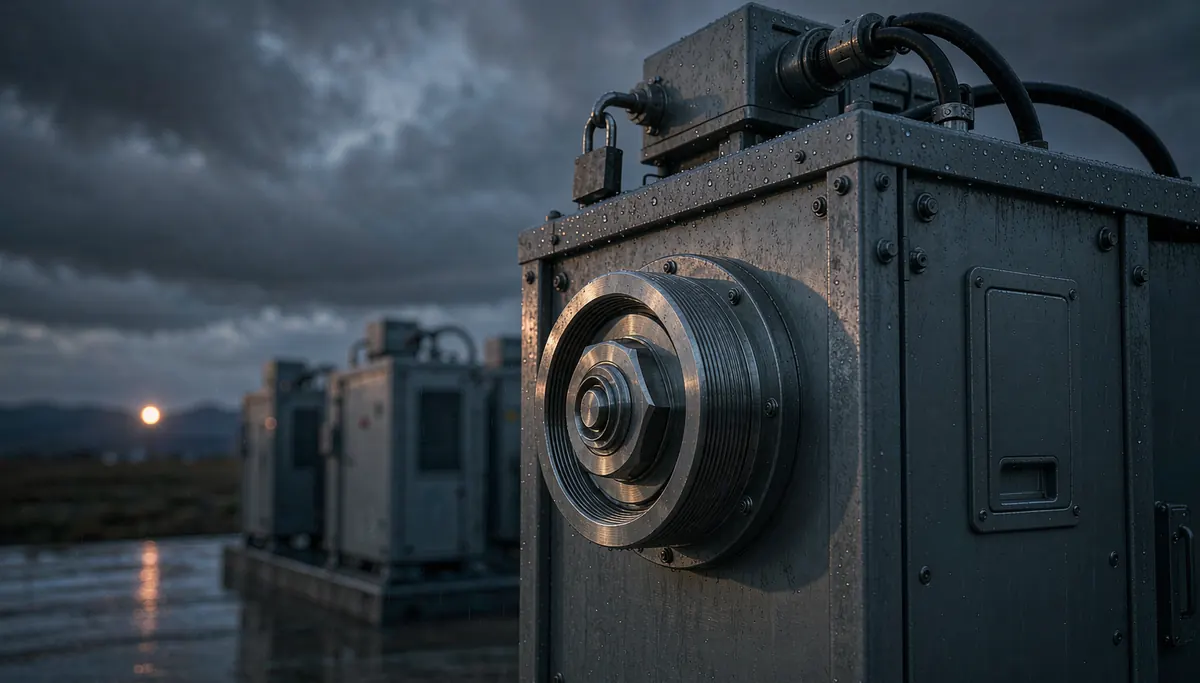
A battery cabinet is asked to hold pressure in two situations that share nothing but the word: the slow rise and fall of a working day, and a cell failure that makes gas in seconds. A vent plug is built for the first, a deflagration panel for the second. Specifying one and assuming the other is covered is where cabinets come apart.
Two pressure events, two different orders of magnitude
Daily breathing sits in the range of tens of millibar. A sealed cabinet going from 25 °C overnight to 60 °C in the afternoon has to move air to stay at atmospheric pressure. If it cannot, pressure builds. On a rigid box the ideal gas law gives about 119 mbar of differential for that 35 K swing, the worst case where the volume does not change at all. Real cabinets flex, so the measured number is lower, but the shape of the problem is right.
A thermal runaway is a different order altogether. Off-gassing from a failing lithium cell raises internal pressure into the kilopascal range, and it does it fast. The gas is also flammable: hydrogen, carbon monoxide, methane, ethylene, plus hydrogen fluoride and electrolyte vapour. Pressure and atmosphere are both the problem at the same time.
Put the two side by side and separate parts stop looking like an upsell. One event is a few tens of millibar over hours. The other is tens of kilopascal in seconds. No passive device covers that whole span.
What daily breathing does to a sealed cabinet
Damage from an unvented cycle is slow and easy to miss until it is expensive. When internal pressure rises it pushes on every seal in the cabinet. Door gaskets, cable gland faces, the joint between panel sections. The gasket compresses further than it was designed to. When the cabinet cools at night the pressure reverses and pulls the gasket instead of pushing it. Twice a day for two years, and the compression set changes. The seal that passed its IP66 test on day one no longer has the same shape.
The other half is moisture. A cabinet that breathes pulls outside air in on the cooling half of the cycle, and that air carries humidity. When it cools further overnight the moisture condenses on the coldest surface inside, usually the backplate or the busbar. That is the mechanism behind condensation in sealed enclosures, and it happens in cabinets that pass every water test you give them.
A vent plug addresses both. The membrane equalises pressure across the cycle so the gasket is never loaded, and the same membrane passes water vapour back out so the interior can dry. It will not pump water out of a cabinet that is already wet, and it will not fix a real leak. It keeps a dry cabinet dry.
Why a deflagration panel does nothing for condensation
This is the part that gets missed when a cabinet is specified against a fire standard.
A deflagration vent panel is a weak point in the structure. It opens at a set pressure, in the kilopascal range, and releases pressure and flame in a controlled direction. Below that pressure it is a solid wall, and it has to be, or the cabinet would not hold its IP rating.
So for all 8,760 hours of a normal year the panel does nothing about breathing. The cabinet still goes through every thermal cycle with its pressure unmet, the gasket is still loaded twice a day, and the first sign of trouble is a fogged window or corrosion on the terminals. The panel is not implicated because it was never in that conversation.
The reverse mistake costs more. A vent plug cannot pass the volume of gas a runaway produces. Membrane area on an M20 plug is a couple of square centimetres. A cell venting into a confined cabinet releases gas at a rate no passive membrane will match, and the pressure has nowhere to go. With no engineered relief path, the structure becomes the relief path.
The two parts are not alternatives. The cabinet needs both, specified against different documents.
Sizing the daily side without oversizing it
The daily side is a flow problem, not a pressure rating problem. Three inputs settle it.
- Free air volume. Not the cabinet's outside dimensions. Subtract the batteries, the racks, the busbar and any ductwork. A 600 × 400 × 200 mm cabinet holds around 35 to 40 litres of actual air once it is full of hardware.
- Temperature swing. Worst case, not average. An outdoor cabinet in direct sun with a dark finish can sit 20 K or more above ambient inside.
- Time allowed to equalise. Usually the fastest part of the cycle, which is the afternoon heat-up.
The pressure calculator on the vent plug size chart runs those three numbers through the ideal gas law and returns the differential, the volume of air that has to move, and the average flow required. It uses textbook physics and no product data, so treat the result as a check on whether a vent is needed at all, not as a promise about a specific part.
One thing to watch when comparing suppliers: airflow figures are quoted at a stated differential, and 70 mbar is the common reference. If your cabinet only develops 15 mbar on a normal day, it will not see the quoted flow rate. Ask for the flow at your differential, or ask for the curve. A number without a pressure beside it is not a specification. The size chart goes through this in more detail.
Thread size follows the volume. M12 × 1.5 covers most outdoor telecom and control cabinets; M20 × 1.5 is where battery racks and high-volume assemblies land. Wall thickness matters as much as diameter, since a cast or reinforced panel needs a longer thread or a different fixing. That is a question for the supplier rather than a table.
Where this leaves the specification
Write the two requirements as two lines on the same drawing.
Line one is the daily breathing requirement: volume, swing, differential, and the flow needed at that differential. That is the vent plug, from the PV / SV / BV range, or a spring-loaded relief valve where pressure has to be shed faster than a membrane can pass it. The openings around it are usually settled at the same time as the cable entries in the same cabinet.
Line two is the runaway requirement: deflagration venting sized to NFPA 68, installed and located per NFPA 855, which is a panel rather than a plug.
The confusion shows up in one specific place: a cabinet that has a deflagration panel because the fire review demanded one, and a vent plug because someone remembered condensation. Both are present, both are correct, and neither is doing the other's job.
If a liquid-cooled pack sits inside, there is a third case worth checking. A coolant circuit can raise pressure quickly without any cell failing, which is the failure the anti-icing relief valve was developed against. A coolant leak is a pressure event without a fire, and it needs a part that can reopen rather than a membrane.