
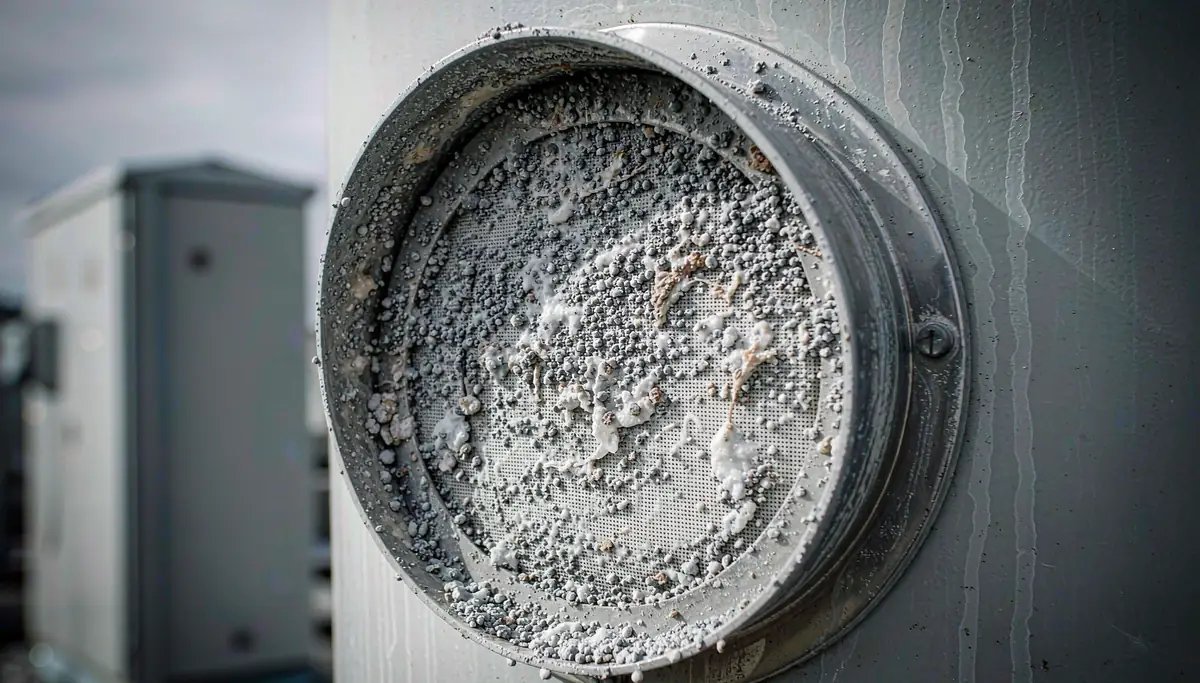
A dust-blocked vent plug can still pass its IP68 retest. The IP code asks whether anything got in, and a membrane that no longer passes air is very good at keeping things out. The one property the part was installed for is the one property the test never measures.
What the IP code measures, and the one thing it never tests
IEC 60529 sets two questions. The first numeral covers solids, meaning can dust reach the interior. The second covers liquid, meaning can water get in under spray, jet or immersion. That is the entire scope, and the whole of it sits on the ingress side of the wall.
Nothing in the standard asks whether air can still move the other way. The standard itself is scoped to ingress and stops there: two numerals, solids and liquids, and a pass or fail against each. There is no airflow figure in an IP report, and no agreed limit for how far a membrane may drift before it stops functioning as a vent. If the buyer does not write a flow figure into the acceptance criteria, none is measured, and the report still comes back clean.
The split between the two numerals is worth keeping straight, since both sit on the same side of the question covered in what IP68 and IP69K each test. Neither rating says a word about breathing.
Gore raised the same gap in a white paper on vent testing, arguing that IEC 60529 was written for large fixed enclosures and does not adequately cover continuous testing of venting products. That paper was about consumer electronics. The exposure is longer on an outdoor cabinet, where the part sits in dust for years rather than a few product cycles.
A vent plug is a filter whose pores are small enough to stop liquid water. Dust does not pass through it either. It collects on the outer face, and unless something removes it, it stays.
Why a clogged membrane can score better on the retest
Run a blocked vent through IP6X and it performs well. The dust chamber applies a pressure depression across the enclosure wall and then checks for particles inside. A membrane already sealed by its own dust load leaves no path for particles, so the interior stays clean.
Immersion reads the same way. IPX7 and IPX8 measure water reaching the interior. A membrane that has stopped exchanging air has also stopped being a route for liquid.
So the part degrades in the one direction the certificate does not look. A loose, cracked or badly seated vent gets caught by a retest. A vent that has quietly stopped breathing does not, and the report comes back clean.
The cabinet, meanwhile, has lost its pressure relief. On a 35 K daily swing a rigid enclosure would see roughly 119 mbar of differential, taken from the ideal gas law with volume held constant. Real cabinets flex and the measured figure is lower, but the direction does not change: that pressure has to go somewhere. It goes through the door gasket, the gland faces and the panel joints, each of which is now doing a job it was never specified for, twice a day. The moisture side of the same cycle is covered in why a sealed enclosure still collects water, and it does not need a leak to get started.
Three failure modes behind the one-to-five-year replacement advice
Published maintenance guidance for this part ranges from annual replacement to five-year intervals. The spread is not vendors disagreeing about quality. It is three different failure modes being quoted as a single number.
- Membrane loading. Dust, salt and oil mist build a layer on the outer face. Flow falls gradually and nothing changes visually until the surface discolours. This is the mode that dominates in a dusty yard or beside a cement bay, and the one no certificate detects.
- Seal compression set. The O-ring or bonded gasket takes a permanent set after enough thermal cycles under load. Once it does, the same torque no longer produces the same contact stress. A water test at the start of life says nothing about year four.
- Mechanical damage. Cross-threaded at installation, over-torqued, cracked by UV, attacked by a solvent. This is the only one of the three that a retest reliably catches.
An annual interval is usually written against the first mode by someone who has watched a blocked membrane take a cabinet down. A five-year interval is usually written against the third, from a bench life figure measured with clean air on the stand. Neither figure is wrong. They answer different questions, and a maintenance plan needs to know which one it is buying.
Checking a vent that is still on the cabinet
The common field check is to press on the enclosure and watch the membrane flex. It answers a yes-or-no question, and the number that matters is not yes or no. A membrane down to a third of its original flow still moves under a thumb.
Two checks hold up better.
- Compare against a new part. Hold a spare beside the installed one and push the same volume of air through each with the same syringe or the same low-pressure source. Crude, but it is a comparison rather than an absolute, and comparisons survive field conditions.
- Measure flow at a stated differential. A flow figure means nothing without the pressure it was taken at, which is why a datasheet quoting 1 L/min at 70 mbar is only usable if the field check uses that same 70 mbar. A reading at half the rated figure means the vent is no longer delivering the airflow the sizing calculation assumed.
Neither check produces an absolute end-of-life number. That has to come from the environment: dust load, solvent exposure, cycle count. A cabinet in a clean indoor room and one beside a cement loading bay do not share a service life, and no single figure covers both.
Put airflow on the acceptance sheet
The practical fix is a paperwork change, and it costs nothing at bid stage.
When a vent plug is specified, ask for the IP rating and the airflow at a stated differential, and put both on the incoming inspection. An IP68 report says the part was intact on the day it was tested. The flow figure is what says it is still a vent and not a plug.
On the maintenance side, tie the interval to the environment rather than to a generic number, and replace on a measured flow drop instead of on a calendar. That also settles the argument about whether the interval should be one year or five, because the part reports its own condition each time it is checked.
If the current spec sheet carries an IP rating and no flow figure, that is the gap to close before the next order. Airflow figures for each thread size are published at a stated differential, and the breathing versus pressure relief comparison covers what a passive vent can and cannot do when internal pressure rises for a different reason.