
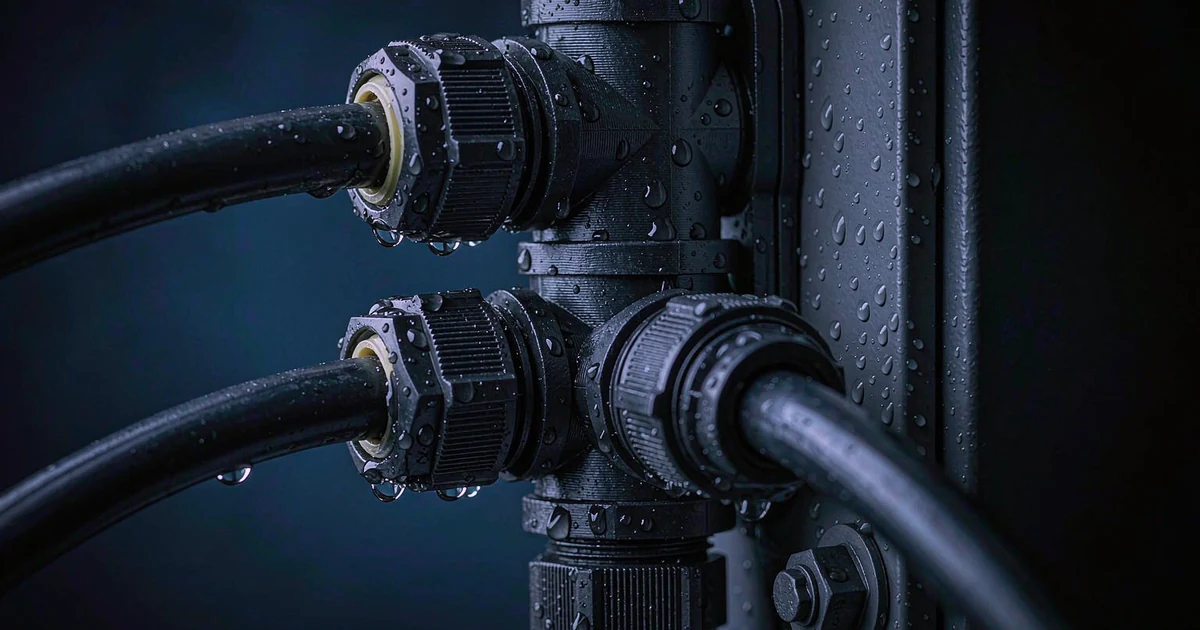
On a single-entry cable gland, IP68 is one seal to get right. On a junction connector with three entries it is three, and the assembly carries only the grade of the worst one. Two entries can be perfect and the joint still fills with water, because water needs one path, not three.
One body, three entries, three different cables
Most sealed joints on the market are designed around cables that match. A tee under a landscape light usually does: one feed in, two out, same gauge, same jacket.
Industrial cabinets are not that tidy. A feeder arrives in armoured cable, one branch runs to a heater in flexible cord, a third drops to a sensor in something thinner. Three cables, three outside diameters, one branch point. A junction box handles this with a gland per cable, which means a box, a mounting plate and three separate glands. A multi-entry connector handles it with one body and three inserts.
What makes that work is that no sealing part is shared. Each entry has its own clamping cap, its own elastomer insert and its own claw. Only the terminal block is common. The cable range is therefore not a single figure for the product. It is one figure per entry, and the entries can carry different inserts, which is how the JC bodies are listed: every entry gets its own range on the sheet.
Locking range decides whether IP68 is real
Every entry seals by compressing an elastomer against the cable jacket. Compression only happens if the jacket sits inside the range the insert was moulded for.
Below that range the insert cannot close on the jacket. What is left is a gap small enough to look sealed from the outside and wide enough to wick water along the jacket into the terminals. Above it the insert is crushed, the cap will not seat fully, and on a plastic body the thread ends up carrying load that belongs to the seal.
Insert count matters as much as the range figure. An M28 body in our range is built with two inserts, S at 10-14 mm and L at 14-18 mm, because one insert cannot cover eight millimetres of jacket variation and still compress at both ends. The M20 body covers 5-12 mm.
Measure the jacket, not the conductor. Cable is sold by cross-section, and the jacket adds a different amount depending on insulation, armouring and stranding, so two cables both sold as 2.5 mm² can differ by several millimetres outside. Caliper the jacket at three points 100 mm apart and take the largest reading. That is the figure the insert has to match. IEC 60529 sets the immersion test; it does not check that your cable is the one the insert was moulded for.
The amp rating belongs to the conductor, not the housing
Suppliers publish current as a range across the whole family, four figures on one sheet, because the limit sits in the conductor and the terminal rather than in the plastic that surrounds them.
A 40 A connector on a 1 mm² conductor is a 40 A connector attached to a wire that will never see 40 A. The figure on the sheet is real. It just does not describe that installation, and nothing on a BOM makes the mismatch visible.
Two checks make the number usable. Confirm which rated current goes with which cross-section. If a supplier publishes several currents and one cross-section range, the sheet is not finished. Then apply the margin your own wiring rules ask for, which is usually that the connection be rated above the circuit's continuous load rather than equal to it.
Voltage is the easier half. Bodies in our range are rated 400-450 V, enough for three-phase industrial circuits, and the figure does not change with pole count.
Inside the cabinet you often do not need IP68
The rating has work to do only where water can reach the joint. Three positions, three answers.
A branch inside a sealed enclosure is already inside the IP68 boundary. A plain terminal block does the job for a fraction of the cost, and a sealed connector adds nothing except a second place to inspect.
Going through the cabinet wall is a cable entry, not a joint. A gland is the right part there, one cable per hole.
A branch on cable outside the enclosure, run between two cabinets or along a mounting rail, is the only one of the three where the joint itself is exposed. That is where a sealed junction connector earns its price.
Telling these apart is worth more than any datasheet comparison. Cabinets get specified with sealed connectors for joints sitting well behind a gasketed door, and exposed branches get taped because nobody owned the decision.
What to check before the drawing is frozen
Four numbers decide whether the part on the drawing holds its rating.
- Jacket outside diameter at every entry, measured rather than read off the cable datasheet
- Cross-section and the current that goes with it, taken as a pair
- Pole count against the circuit: M20 bodies come in 2 and 3 pole, M25 and M28 in 3 and 5 pole, and there is no 4-pole body in this range
- Where the joint sits, inside the enclosure boundary, through it, or outside it
Send those four with the enclosure drawing and the thread, insert and pole count follow without guessing. Send a catalogue number on its own and you get the thread right and the seal wrong.
If the joint does end up outside a cabinet, it raises the same question as any other cable entry, and sealing every entry on an outdoor cabinet works through the boundary end to end. Cabinets that also have to breathe carry a separate constraint, set out in IP67, IP68 and IP69K.