
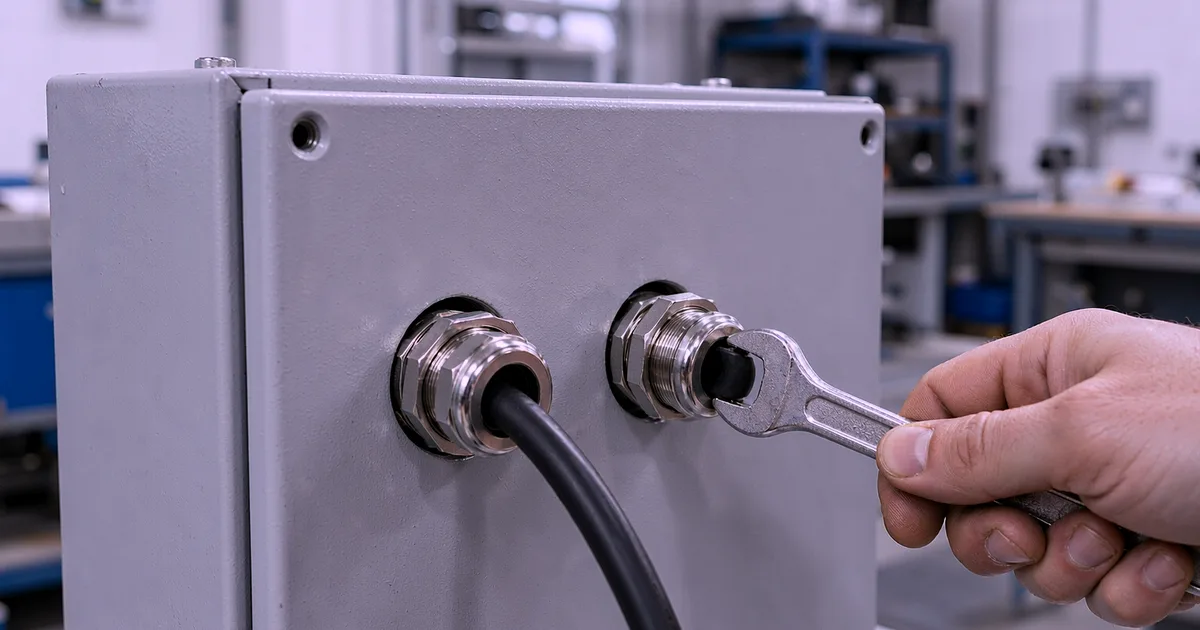
One sealing point per cable is the rule that holds IP68 without argument. When a cabinet has one hole and several cables, the workable paths are a multi-hole sealing insert, a junction connector body, or a second drilled hole. What never works is pushing two cables through a single-cable gland: the clamp compresses around one round jacket at one diameter, and two cables leave a gap that no seal can close. Here is where each option fits, and the mistakes that turn a watertight entry into a slow drip.
Why one cable per sealing point is the default
A standard cable gland seals the same way on every panel. A clamping seal compresses onto the round outer jacket, the compression depth depends on one number, the cable outside diameter, and the thread seals against the panel wall independently, provided the hole under it matches the thread (the hole size table lists every entry diameter). That is why the catalogue lists a cable range for each thread: the M20 stainless gland on our site takes 6 to 12 mm jackets, the PG13.5 takes 6 to 12 mm, the M25 takes 13 to 18 mm. Fit a cable near the middle of the range and the seal has margin on both sides. Fit a cable near the edge and every tolerance stack works against you.
Splitting cables across separate entries also buys three things that matter later in the panel's life. Each cable can be replaced without touching its neighbours. Each entry carries its own strain relief, so pulling one cable does not load the seal of another. And each gland stays inspectable: an installer can see at a glance whether every jacket is gripped and every locknut is tight. This is the default for a reason, and it is worth disrupting only when a real constraint pushes back.
The three ways several cables share one opening
The constraint usually looks like this: a casting with one threaded entry, a panel where drilling a new hole means disassembly, or a retrofit where the original knockout is already occupied. Three solutions cover almost every case.
A multi-hole sealing insert. One gland body with a sealing plate pierced by two, three or four openings, each port gripping its own jacket. The selection logic stays the same as a single gland, only repeated: count the cables, measure each outside diameter, then match the insert. The detail that trips people up is mixed diameters. A stock insert often assumes similar jackets in every port; cables that differ by several millimetres need an insert drilled for that combination, which is a quotation conversation rather than a catalogue pick. Round jackets only: a flat or oval cable cannot be gripped by a round port.
A junction connector body. Where the cables are joining rather than passing through, a waterproof junction connector solves the problem at a different point in the run. Our JC series, for example, takes one incoming cable and splits it to two or three outgoing positions through a sealed body, with conductor counts from 2P to 5P and wire ranges from 5 to 18 mm depending on the variant. The entire shell carries the IP68 rating, so the entry count on the cabinet does not change at all. This suits outdoor lighting runs, pump leads and garden wiring where the splice itself is the vulnerable point. It is not a substitute for panel entries: a junction connector sits in the cable run, not on the enclosure wall.
A second hole. Sometimes the honest answer is another entry. It costs a drilled hole, a gland and a few minutes, and it preserves every advantage of the one-cable-one-seal default. When the hole count is the sticking point, reducers for oversized knockouts and rated blanking plugs for unused ones are the cheaper fix than redesigning the entry scheme.
What actually breaks the seal
The field failures we hear about are rarely exotic. They fall into a short list.
Two cables pushed through one gland is the most common. The clamp grips where it can, one jacket takes the compression and the other sits loose, and the entry weeps the first time the cabinet is hosed. The failure is not dramatic, which is why it survives inspection: a damp patch below the gland plate in week six, corrosion by month three.
Mixed diameters in a stock multi-hole insert come next. A 4 mm sensor lead and an 11 mm power cable asked to share an insert sized for the power cable leaves the small jacket swimming. Port-to-port matching is the whole point of the insert; order it per cable, not per gland.
Blank positions left open quietly downgrade the whole assembly. An unused port on a multi-hole insert, or an unused knockout next to the gland, is a hole with no seal. Each blank needs a rated plug, the same IP discipline the rest of the entry carries.
And in hazardous areas, none of this is a swap-in. Multi-hole inserts are not an Ex-certified entry method on their own; certified entries follow the certificate, not the convenience.
Choosing in ten seconds
Cables joining mid-run outdoors, the splice is the weak point, so a sealed junction connector carries the rating for you. Cables passing into a cabinet through one fixed entry, count them, measure every outside diameter, and specify a multi-hole insert per cable. Anything else, drill the second hole and keep the default.
Whatever the route, the ten-second bench check stays the same: every jacket gripped, every unused position plugged, every locknut torqued. If you send us the cable count, each outside diameter and the panel hole size, we will match the entry and quote the parts in one pass.