
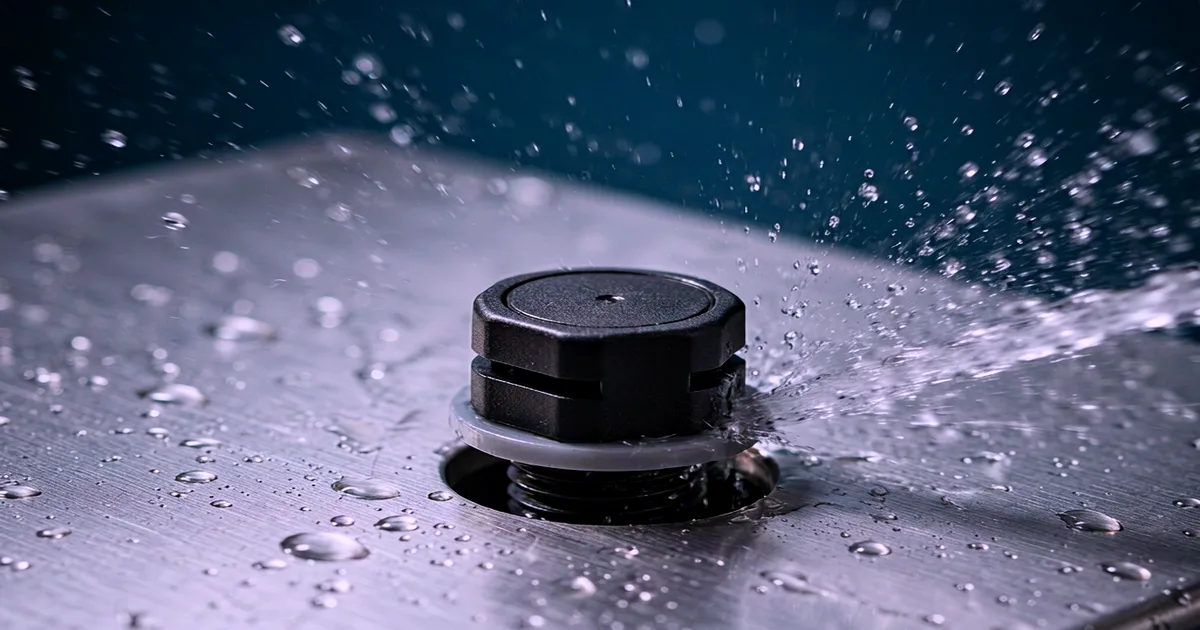
An IP69K cabinet and a breather vent are not enemies, but they have to be specified together. The vent is the only component in the wall whose working surface faces the jet directly, and it is the part most datasheets go quiet about. On a washdown line, the membrane usually loses to the cleaning chemistry long before the cabinet loses to the water test.
Where the IP69K rating stops
The test itself is short and violent. ISO 20653, which carries forward the German DIN 40050-9 procedure, fires 80 to 100 bar water at 80 °C from a nozzle held 100 to 150 mm away, at four angles of 30 seconds each (0°, 30°, 60° and 90° from the horizontal part surface), on a turntable rotating at about 5 rpm. Flow is 14 to 16 litres per minute. Compared with IPX6, the powerful-jet test at 100 kPa from 3 m, the IP69K jet delivers roughly eighty times the pressure from a fraction of the distance, and it drives hot water into every seam on the box. A full breakdown of how that test differs from IP67 and IP68 immersion is in an earlier note on what each rating actually tests.
The rating belongs to the assembly that was on the rig. A cabinet certified IP69K with a separately bought IP68 vent screwed into its wall is, at the vent, an IP68 enclosure. The turntable does not grade components by importance; the jet treats a membrane like any other gasketed surface. So the first question on a washdown project is not whether the cabinet passed, but what exactly was mounted during the test, vent included or not.
Two names for roughly the same jet complicate the paperwork. IP69K comes from ISO 20653, the road-vehicle standard that inherited the DIN 40050-9 procedure. IP69, sometimes written IPX9, is the designation IEC 60529 added for the same class of high-pressure hot-water jet in its own general test document. The two rigs were developed separately and the reports are witnessed against different standards, even though the spirit of the test is the same: a close-range 80 °C jet, four positions, a rotating fixture. Datasheets use the names loosely, and for a breather vent the practical difference is small. What matters is that the drawing carries the designation the test report actually used, because that is the document a certification auditor will ask to see.
The test runs on plain water. Your line does not
Every IP water test, including IP69K, runs on hot water alone: no detergent, no steam, no solvent, no foam. Chemical compatibility is a separate question the standards never ask, and washdown lines make it the biggest question of all. Food, dairy and pharmaceutical cleaning uses alkaline caustics at elevated temperature, and surfactants do most of the actual work.
Surfactants are the quiet killer for membranes. An ePTFE membrane holds liquid water out because of its surface chemistry, and surfactants exist to defeat exactly that property. Once cleaning fluid wets out the pores, liquid water walks through, airflow collapses, and the vent stays out of service until the membrane dries. On a line cleaned nightly, a membrane that never fully dries between shifts can leave the cabinet without a working breather for its entire life. Oleophobic treatments resist oils and surfactants, which is why the treatment grade matters more than the IP digit printed on the label.
Thermal cycling from the 80 °C jet adds a second failure path that immersion testing never applies. It works on the housing plastic, the gasket, and the bond or weld that holds the membrane in place. A part that shrugs off a 30 minute soak can still lose a bonded membrane after weeks of hot-cold cycles in caustic fluid, and the failure shows up as exactly the kind of gap the jet was looking for.
Placement buys margin, not rating
Because the turntable sprays every face, mounting position does not buy the rating. What it buys is margin in service, and service is where enclosures actually live. A vent mounted high on the cabinet, tucked behind a door lip or a shroud, sees a wetted environment instead of a direct jet. One mounted flush on the jet-facing panel at the bottom, where cleaning fluid pools, sees the worst of both: direct impact and standing caustic.
Two details cost nothing at install time and remove the most common service failures on vented washdown cabinets. Seal the mounting thread so fluid cannot wick past the shank, and give the area below the vent a drip path away from any connector or entry below it. The logic is the same one behind cable entry sealing on outdoor cabinets: keep the vulnerable surface out of the direct weather, whatever that weather happens to be.
Five questions before you sign the spec
- Which document? IPX9 sits in IEC 60529, IP6K9K in ISO 20653. Test conditions are close and datasheets use the names loosely, so ask which standard the test report cites.
- What was on the rig? The bare enclosure, or the enclosure with vent and glands installed? Only the second answer covers your real build.
- Is the membrane oleophobic, and to what grade? This is the line of defence against detergent wet-out, and suppliers rarely print it next to the IP code.
- What happens after wet-out? Does the datasheet state anything about airflow recovery in surfactant fluids, or silence on the subject?
- What holds the membrane? At 80 °C cycles the bond matters as much as the membrane. Housing polymer and adhesive age differently in caustics, and the difference eventually shows up as a leak path.
When IP68 is still the right answer
Washdown is a zone, not a property of the cabinet. An outdoor control cabinet that gets hosed down twice a year with a domestic-pressure lance does not need an IP69K vent. An IP68 part with sensible placement does the same job for less money, and there is no shame in saying so on the drawing. A nightly caustic cycle at 80 °C is a different environment, and that is where an IP69K-rated vent earns its price.
Sizing the vent for a given cabinet, thread and airflow, follows the numbers on the vent plug size chart. If the wet zone cannot be avoided, a breathable cable gland can move the breathing path to the cable entry, where the gland is designed for the wet face in the first place.
Read the cleaning schedule before reading the IP code. The cabinet usually passes the water test. The membrane is what faces Tuesday night's caustic cycle, every week, for years.