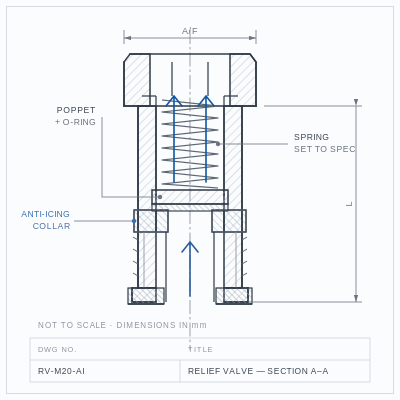
Spring-loaded relief for liquid-cooled battery packs and large sealed cabinets, where a membrane alone cannot shed a fast pressure rise. An anti-icing collar keeps the seat free at sub-zero temperatures.
Opening pressure is not a catalogue figure on this part — it comes from your drawing. The rows below say what is fixed, what is set, and what is still open.
| Property | Value |
|---|---|
| Part number | RV-M20-AI |
| Type | Spring-loaded pressure relief valve, anti-icing seat |
| Thread | M20×1.5 |
| Body material | PA66 / SS304 |
| Relief element | Spring-loaded seat — not a membrane |
| Opening pressure | Set to your specification |
| Anti-icing | Collar keeps the seat free at sub-zero temperatures |
| IP rating | Target: IP68. Not an achieved rating, and no third-party report is held. |
| Production status | Engineering sample — joint development against your pack drawing |
| Operating temperature | Data on request — set by the seat and spring grade |
| Flow capacity | Data on request — depends on set pressure and seat area |
| Ordering | Project-dependent. Quote against a drawing — contact |
A membrane equalises pressure slowly, which is what a cabinet needs across a day of heating and cooling. A cell venting into a pack raises internal pressure in seconds. Slow equalisation is not a relief path for that, and no pore size makes it one. This is a spring-loaded seat that opens at a set pressure.
Condensation inside the pack, or coolant from a failed joint, sits on the seat. At sub-zero the water freezes and the seat is held shut by ice rather than by the spring. The pack then has no relief path exactly when a cold-start charge is raising pressure. The anti-icing collar keeps that seat free.
Three inputs usually decide it: what the enclosure structure can take, what the cell specification requires, and what the gasket will tolerate. Give us the number from your drawing and the seat is set to it. We do not publish a default, because a wrong default on a pack is worse than no default.
IP68 is a target on this part, not an achieved rating. It is at engineering-sample stage and has not been third-party tested. On a part sold against a drawing, saying so is more useful than a number.
Three applications where the pressure event is too fast for a membrane.
Coolant is inside the enclosure and a seat can ice. Both facts are the reason this part exists rather than a vent plug.
Volume is big enough that a fast pressure event cannot be handled by a breather, even a large one.
Cold-start duty cycles and wash-down, both of which stress the seat in ways a passenger-car duty cycle does not.
The same M20x1.5 footprint, for packs where a visual state check matters more than relief.
Pressure rise per temperature swing, the airflow a cabinet needs, and the arithmetic behind it.
Why tens of mbar and tens of kPa cannot be served by the same part.